When you can't get to your precinct

A few days ago, due to the threat of a chemical explosion, 50,000 people in Orange County were under evacuation orders.
In the midst of this, there was an active primary election – election day was June 3rd, but early voting was available for a couple of weeks prior – and Californians are big users of alternate voting methods like vote-by-mail and early voting.
You might be wondering – how often are elections rescheduled due to natural disasters or other emergencies? The answer is... almost never. Two notable exceptions: the local primary in New York City on September 11th was rescheduled by two weeks, and some March/April 2020 primaries were rescheduled due to COVID. Interestingly, over the last 40 years, no general election has ever been rescheduled in the United States.
So, for a "mere" 50,000 people evacuated? The election goes on.
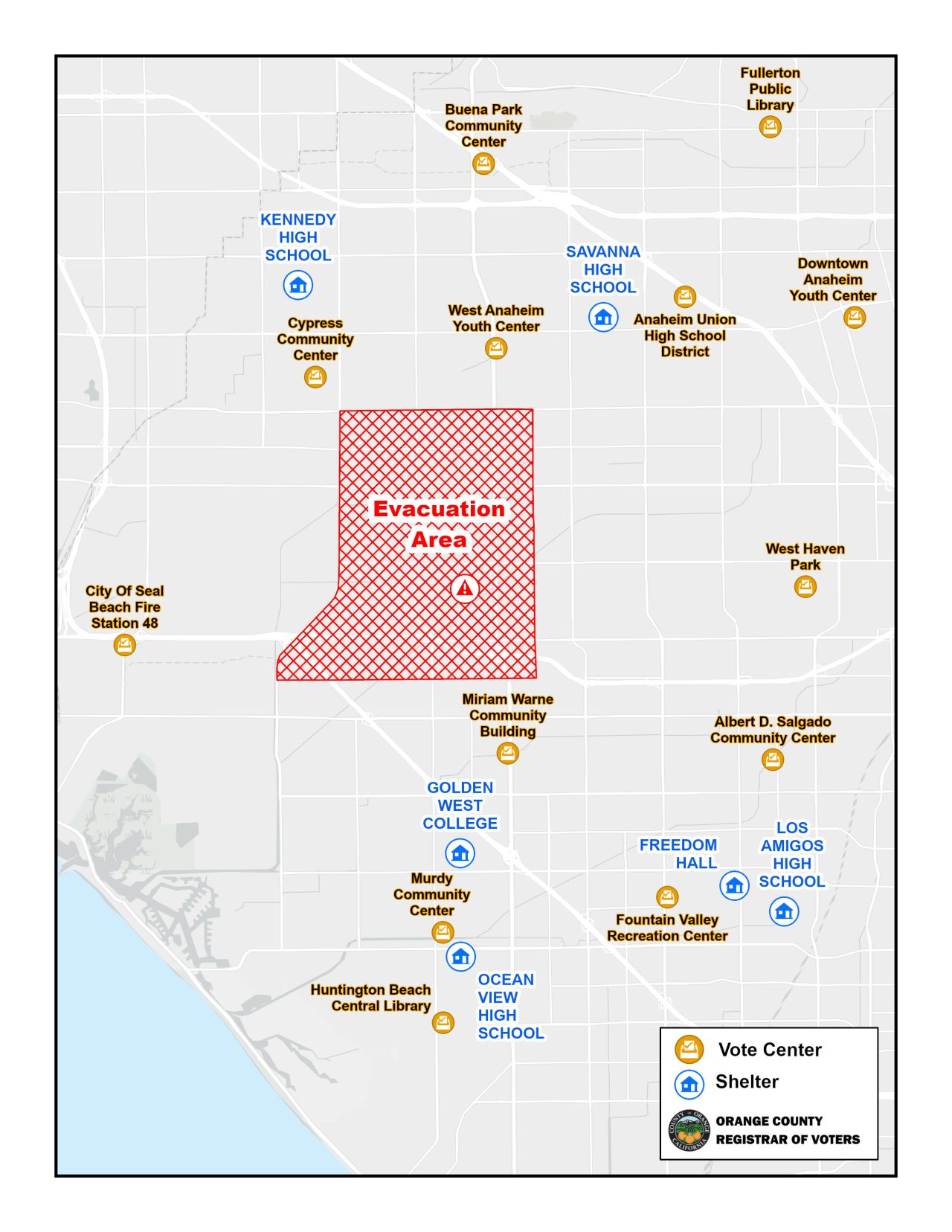
Fortunately, the Orange County clerk posted on LinkedIn that 38 vote centers were available for early voting outside of the evacuation area:
 Bob Page
and he included a convenient map:
So... what's a vote center?
Historically, in the US and in most democracies, voters have had to vote at a designated location based on where they live. This is important for two major reasons:
- your ballot may be different depending on where you live, given local contests like school board, and
- to ensure each voter gets to vote only once, each voter appears on the voter rolls at only one designated location.
Since 2003, this model has been changing. A number of states, including California, allow their counties to set up vote centers where any voter, regardless of where they live in the county, can choose to vote. In some states, this model is only available during early voting, and in other states it's available on election day, too.
The key idea is simple: we should make it easy for eligible voters to cast a ballot, and voting anywhere in the county is just more convenient. Voters can vote near home, or near work, or near a doctor's appointment they may have that day. Plus, as Orange County just demonstrated, it's also more robust – if some vote centers have to be shut down for any reason, voters can still vote at other locations.
Technology adapted to vote centers
Now, if voters can vote anywhere in the county, how do we make sure voters only vote once? We need a way to coordinate voter checklists across voting locations, so a voter can't vote at 9am at one location, and then at 10am at another. We could always catch these double-voters after the fact when lists are reconciled, but, by that point, the votes would already be cast and would be impossible re-identify and revoke, so the damage would be done. Thus, we have to prevent double voting at the point of voter check-in.
And how do we make sure voters get the right ballot? We need every ballot style available at every location in the county. And in the right language! Orange County is very large, with almost 2 million registered voters, which is larger than 16 states. They have approximately 600 ballot styles and officially support 5 languages, which means there are 3,000 different ballot configurations that need to be available at every vote center.
Choosing voter convenience is admirable, but it comes at a significant operational cost that we have to acknowledge and fund.
Electronic Pollbooks
The solution to synchronizing voter checklists across vote centers within a county is Electronic Pollbooks. Voters are checked on a laptop or a tablet, and that check-in record is rapidly synchronized, over the Internet, to other vote centers.
This takes a good bit of infrastructure – electronic pollbooks, sometimes called ePollbooks, must be purchased from a vendor, and each location needs reliable Internet connectivity. ePollbooks must be loaded with the latest voter list right before the election. In large jurisdictions, that synchronization can take some time.
And of course, ePollbooks are separate from tabulators: the ePollbook knows who you are but not how you voted, while the tabulator knows how you voted but not who you are. They must remain completely separate.
Now, ePollbooks introduce a potential weak point in the overall voting system – if the Internet goes down at a vote center, or if the devices malfunction in some other way, voters can no longer be checked in, and voting actually stops. This is worse than if the tabulator stops scanning ballots, because, in that case, voters can always cast a ballot in the emergency bin for later scanning & tabulation.
So, ePollbooks are necessary to give voters a choice of voting location, but they have to be managed particularly well – election administrators should pick a model that is robust to these types of failures.
Ballot On Demand and Ballot-Marking Devices
Once voters are checked in, there's still no way for Orange County to keep 3,000 different ballot configurations stocked at every vote center. So, instead, they print ballots on demand. When the voter is checked in, their ballot style is entered into a special-purpose ballot printer. The ballot is printed right there and then as the voter waits, and is then handed to the voter to fill out and scan.
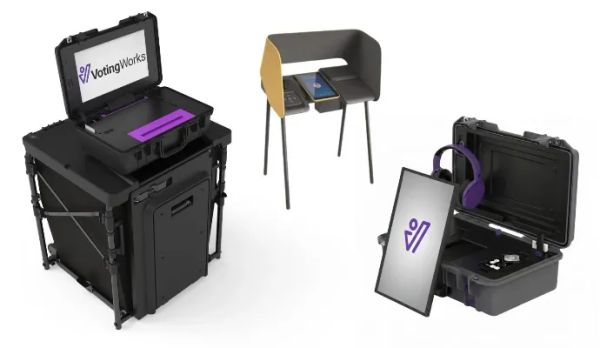
Meanwhile, nearby Los Angeles County, an even larger voting jurisdiction with 6M registered voters, 19 languages, and tens of thousands of ballot configurations, chooses a different option: ballot-marking devices, where voters prepare their ballot on a touchscreen, and the fully filled out ballot is printed for the voter to cast.
In both cases, there is no generic ballot stock just lying around. Either a blank ballot is dynamically printed, or a filled-out ballot is dynamically printed. In large counties, that's the only way voters can have the flexibility to vote at any location.
Tradeoffs
Like any complex system, voting requires making tradeoffs – and the decision isn't always easy. If you want to give voters flexibility on where to vote, you'll need more equipment and more associated processes to manage. And what works for Orange County may be completely inappropriate for a small rural county with single thousands of voters, and vice-versa. Voting systems in the US are not centralized, in part because different jurisdictions have different needs.