Why do we need voting machines?

Over the last few days, elections were held in a number of European countries:
- national elections in Slovenia [Politico]
- mayoral elections in France [NYT]
- national elections in Denmark [The Hill]
If you click through on the articles above, you'll find photo evidence that in all of these elections, voters use paper ballots cast into simple plastic or cardboard ballot boxes, and then ballots are counted by hand. Results are available late on election night.
So, why don't we just do the same thing in the US? Why do we need voting machines?
Let's take a look closer to home.
Two weeks ago, March 10th, 2026, was election day for towns across the state of New Hampshire. In the town of Goffstown, they had a contest for the Budget Committee, a vote for up to 4. Once the polls closed and all write-ins were adjudicated, the computed tally was very, very close. The candidate in fifth place was 2 votes behind the candidate in 4th place, 1476 to 1478. (PDF)
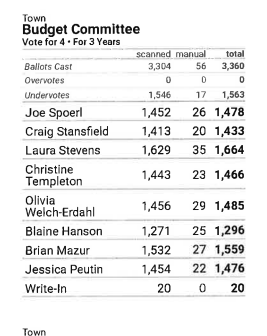
It was, of course, very reasonable for the candidate in fifth place to request a recount for this contest, given how tight the race was. So the town of Goffstown performed a full hand recount of just this contest. Here's the result of that recount (PDF):
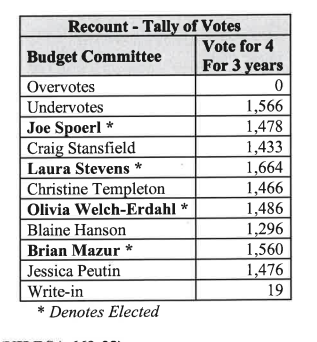
Note that the hand count did adjust two candidate totals, each by 1. In one case, it was a ballot that was mistakenly not scanned. In another case, it was a write-in that had not been adjudicated properly the first time around. These were both fully understandable human errors. The outcome was unchanged – the same four people were elected, and the vote counts for the 4th and 5th candidates remained the same, 2 votes apart.
So, once again, why don't we just count votes by hand? And why am I giving you these details, other than to brag about how accurate VotingWorks tabulators are?
Because the recount of this one contest took 5 people 20 hours to perform. To be fair, they had a rough count after 3-4 hours. But to get every last vote counted properly, it took that long, and it was particularly tedious.
Now, keep in mind that's just one contest. The town of Goffstown had a 38-contest ballot. So we're talking almost two person-years of business hours to count the whole ballot for a town of roughly 12,000 residents.
And that's the complexity of a single town. In larger jurisdictions, like counties with dozens or hundreds of different ballot styles, possibly cast at vote centers where the ballot styles intermix because anyone from the county can vote anywhere, now you're talking about first segregating the ballots by style, and then counting the ballot styles independently. It's not going to get any faster.
Why do we need voting machines in America? Because US ballots are dramatically more complex than European ones.
In the US, we do things a bit differently than in Europe:
- our ballots are much longer: dozens of contests instead of just 1 in most European elections. Some of those contests are vote-for-3. For both of those reasons, you can't make piles of like ballots that you subsequently count.
- our ballots vary in the contests they include from town to town, district to district, county to county. There's some degree of variability in Europe, too, but nothing like the complexity in the US. Many US counties have dozens of variations, some multiple hundreds.
- our ballots are often offered in multiple languages. European countries, save a couple of exceptions, have only one language. Los Angeles County has ballots in 19 languages.
If we were to hand-count all ballots in America, the time it would take, the money it would cost, and the accuracy we would lose, would be unacceptable. The Elections Group has a great report that explains this in depth.
If you want to learn more about voting machines, why we use them, and the different kinds of voting machines we have in the US, check out my corresponding podcast episode.